A missing term turned a $4.8M refund into a $6.6M bill
A Massachusetts utility's cost-adjustment formula left out one term for five years. New auditors found it, and the refund customers expected became a surcharge. Six questions to ask before you correct a formula like it.
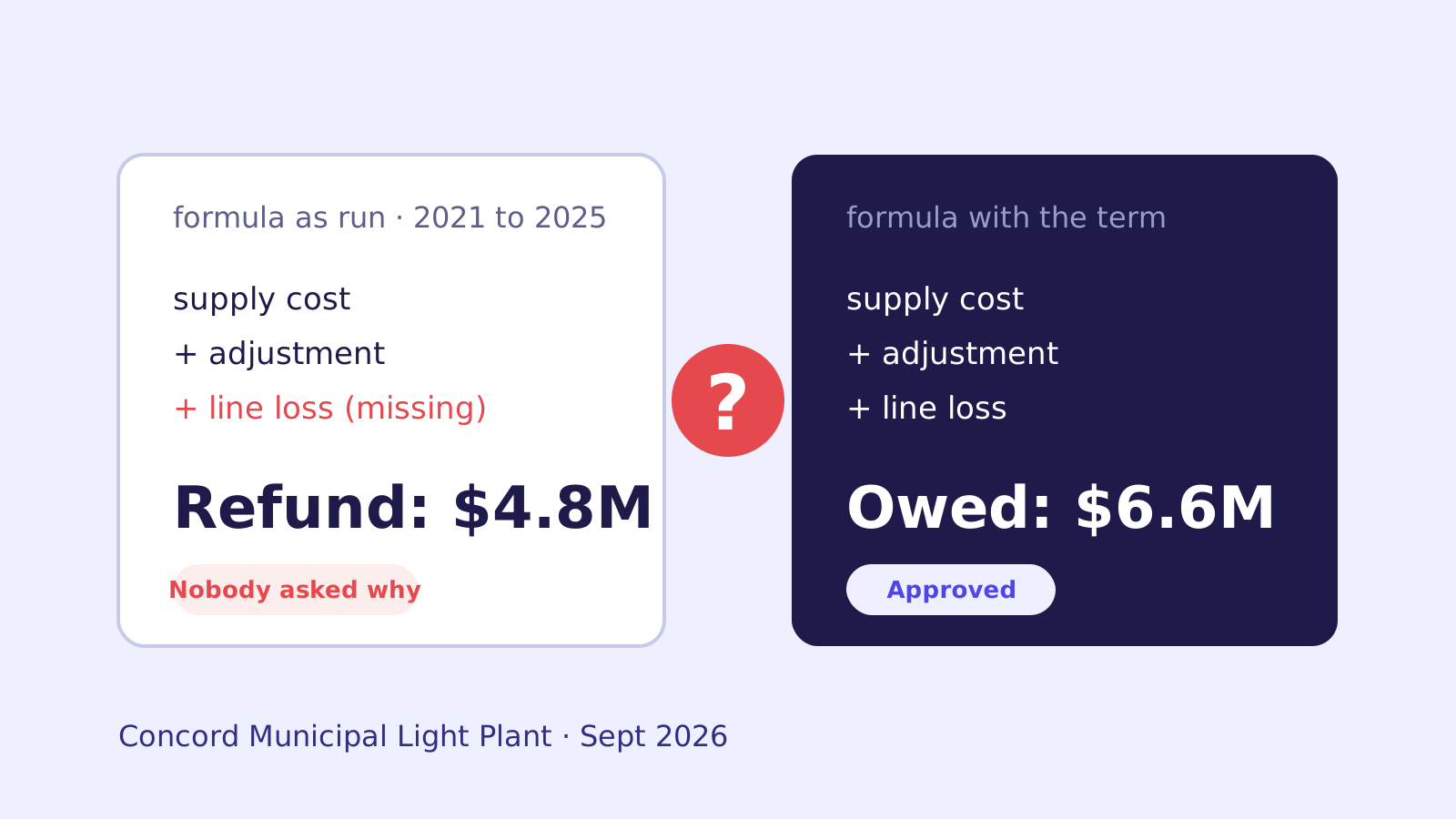
On 23 September 2026 the Light Board of Concord, Massachusetts, approved a surcharge of $0.00728 per kilowatt-hour on the town’s electricity customers. New accountants reviewing the utility’s 2025 financial statements had found that its power cost adjustment formula, in place since 2021, left out “line loss”, the electricity lost as it moves through lines and transformers. On the old formula, officials believed customers were owed $4.8 million in refunds. With line loss included, customers had been paying too little, and the shortfall was $6.6 million1.
The average household now pays about $400 over five years, and a monthly credit worth about $3.70 has disappeared from bills. One board member said he was concerned that “we and the former auditors look like dummies for not knowing about this”1.
Why did the answer flip sign?
The formula tracks changes in wholesale power prices. With the term missing, the formula showed customers as overcharged, and a monthly credit appeared on their bills for years. Every month the credit showed up, it looked like proof the formula worked1.
A wrong formula that favours the customer is hard to see for that reason. Nobody complains about a credit. The error stayed until someone outside the process recomputed the whole thing.
Who knew line loss belonged in it?
The article does not say why the term was missing. It does not say whether someone removed it or it was never there. That gap is the useful part. A formula is a decision about what counts. When a term is absent, you cannot tell from the formula whether that was a choice or a slip.
The answer lives with a person, usually the one who set up the formula or approved the tariff language it implements. If they have moved on, it lives nowhere.
What should you ask before you correct a formula?
Run these six on any rule that calculates a price, fee, rate or credit:
- What does the written promise say it includes? Tariff, contract, rate sheet or policy. Quote the sentence.
- What does the rule actually include? List every input the code reads. Compare the two lists term by term.
- When did the two last agree, and what changed? Find the change that opened the gap, and who made it.
- Which direction does the error run? If customers were favoured, the fix is a collection problem. If they were charged too much, it is a refund problem. Different teams own each.
- Who approved the correction, and on what basis? In Concord the utility’s director said he did not think auditors would allow it to absorb the loss itself1. Someone has to own that call, in writing.
- What replaces the signal customers were reading? The credit disappeared at the same moment the surcharge began. Customers saw both in one bill.
Question 3 is the one most teams cannot answer in a day. The commit that dropped a term rarely says why.
Does an audit find this, or does something earlier?
Here an audit found it, after a change of accountants. The former auditor had signed off on years of statements built on the same formula1. Sampling checks outcomes. It rarely checks whether the rule that produced them contains every term the tariff names.
The cheaper moment to find it is the day the formula is first written, or the day an approved rule changes in the code.
How does AppThentic find a rule like this?
om reads the calculation in the system: what it takes as inputs, what it leaves out, and since when. It reads the tariff, contract or rate sheet you load as a source. Where the rule and the written promise disagree, the rule is marked Disputed, with both sources side by side, until its owner settles it.
When nothing written down explains why a term is absent, om asks the owner the narrow question: “The formula includes A and B. The tariff also names line loss. Is it meant to apply?” The owner either gives the reason, which is approved and kept in Organization Memory with its source, or says it should apply, which is a defect found before an auditor finds it. Every answer shows its source, its owner and its status.
Once a rule is approved, om watches it. If the code changes, the rule becomes Stale and its owner is asked again, so a later release cannot quietly drop a term. Risk and compliance get a list of rules that disagree with a written promise, ranked by the money and customers they touch. See When the system breaks a promise and Keeping answers current.
What is the lesson for a company that is not a utility?
A price formula is a promise written in code. If one term is missing, the error can run in either direction, and a credit that appears on every bill is not evidence that it is right. For Concord, the cost of finding the gap late was five years of underbilling, a surcharge, and a change of auditors. Finding it before a release costs one question to one person.
To see this on your own systems, book a walkthrough.
Sources
- The Concord Bridge, via Yahoo News, A 5-year billing error is adding $6.74 a month to Massachusetts power bills (15 October 2026)